
When you hear the words “blimp” or “zeppelin,” your mind probably drifts straight to a grainy newsreel of the 1937 Hindenburg disaster. For nearly a century, that single tragic event effectively grounded the lighter-than-air aviation industry. As a result, airships were anchored to history books or limited to the occasional sports stadium flyover.
However, a major shift is currently occurring in our skies. Driven by the urgent need to slash global carbon emissions, aerospace engineers are completely rethinking how we move cargo. Consequently, airships are making a remarkable comeback. The aviation industry now realizes that the floating giants we once abandoned might actually hold the key to a sustainable, low-carbon future.
The Environmental Problem with Modern Aviation
Conventional air travel remains a massive climate disaster. Commercial jet airliners require immense amounts of fossil fuel simply to overcome gravity. They must burn fuel continuously to lift thousands of pounds of steel into the sky. Furthermore, high-altitude emissions from these jets trap heat in the atmosphere, which accelerates global warming at an alarming rate.
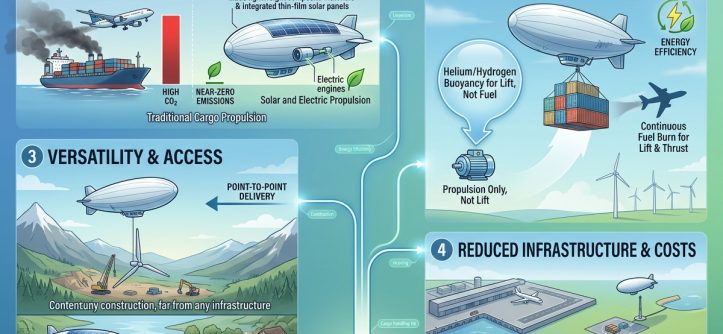
Airships approach the physics of flight from a completely different angle. Instead of using raw engine power to force heavy metal through the air, they utilize aerostatic lift. This means they rely on a gas that is inherently lighter than the surrounding air to float effortlessly. While early engineers used volatile hydrogen, modern teams rely exclusively on safe, non-flammable helium. Because gravity is countered naturally by buoyancy, engines are only needed to move the craft forward.
As a result, this fundamental difference changes the game for environmental efficiency. Modern hybrid airships cut carbon emissions by 75% to 90% compared to traditional cargo jets. In addition, when next-generation variants adopt fully electric or hydrogen fuel cell drivetrains, that pollution number will drop to zero.
Reaching the Unreachable: True Point-to-Point Logistics
Beyond their carbon-slashing capabilities, modern airships solve a massive infrastructure bottleneck. Conventional airplanes require miles of asphalt, heavy ground crews, and complex airport hubs to function. Therefore, remote areas are often completely cut off from global supply chains. To reach them, industries must rely on slow, destructive road construction or highly inefficient heavy-lift helicopters.
Conversely, airships require zero traditional runway infrastructure. By utilizing vertical takeoff and landing (VTOL) systems alongside advanced vectoring thrusters, they can hover over completely undeveloped terrain. This allows them to load and unload cargo almost anywhere on Earth.
- Remote Industry Access: Logistics teams can transport massive components, like 80-meter wind turbine blades, directly to rugged mountain ridges. This eliminates the need to build expensive logging roads through pristine forests.
- Immediate Disaster Relief: Pilots can drop thousands of tons of medical supplies, food, and water directly into flooded zones. This is vital when local roads and runways have crumbled.
- Supply Chain Relief: Freight forwarders can bypass gridlocked deep-sea ports and major highways. They can accomplish this by moving goods straight from a manufacturing facility to a regional distribution hub.
Leading the Charge: The Modern Airship Fleet
The dream of future airships is no longer confined to digital blueprints. In fact, several aerospace innovators are currently conducting real-world flight tests and signing major commercial partnerships.
LTA Research: Pathfinder 1
Backed by significant tech investment, Google co-founder Sergey Brin’s company, LTA (Lighter Than Air) Research, is actively flying its massive Pathfinder 1 prototype. Measuring over 400 feet long, this rigid-body electric airship recently completed successful test flights outside its hangar over the San Francisco Bay. LTA Research is using these trials to prove the safety, stability, and scaling capabilities of zero-emission electric flight for humanitarian aid.
Hybrid Air Vehicles: Airlander 10
The British-designed Airlander 10 is leading the charge for commercial regional travel and freight. It combines buoyant helium lift with the aerodynamic profile of a fixed-wing plane. Because of this hybrid design, the Airlander 10 can stay aloft for five days straight when crewed. The standard combustion model reduces emissions by 75%. Meanwhile, the company plans to introduce hybrid-electric configurations by 2029 and go fully electric by 2030. Major logistics corporations like DHL Global Forwarding have already stepped up to pilot these routes.
Flying Whales: The LCA60T
France-based Flying Whales is designing a rigid airship engineered explicitly for heavy industrial transport. Capable of carrying a massive 60-ton payload, the LCA60T is designed to hover over dense forests or rugged terrain. It lifts timber, wind turbine parts, or heavy machinery straight into its belly without ever touching the ground. A recent strategic partnership with European logistics giants highlights the industry’s serious push to integrate these giants into global freight networks.
Comparing the Options: Airships vs. Traditional Logistics
| Capability | Cargo Airship | Conventional Jet | Ocean Freighter |
| Carbon Footprint | Extremely Low (90% reduction) | Very High | High (Heavy Fuel Oil emissions) |
| Infrastructure Needed | Minimal (Flat 100m clearing) | Massive (Runways, Customs hubs) | Massive (Deepwater seaports) |
| Speed | Moderate (~60–80 mph) | Fast (~500 mph) | Very Slow (~15–20 mph) |
| Payload Capacity | High (10 to 100+ tons) | Moderate to High | Massive |
| Point-to-Point Delivery | Yes (Direct to destination) | No (Requires trucks/trains) | No (Requires trucks/trains) |
The Roadblocks Ahead
While the ecological and logical benefits are undeniable, the airship renaissance still faces significant challenges:
- Weather Vulnerability: High atmospheric winds remain the ultimate enemy of lighter-than-air vehicles. Wind speeds exceeding 35 knots can severely complicate docking, launching, and navigating. Therefore, advanced real-time meteorological routing is essential.
- The Helium Supply Chain: Unlike the volatile hydrogen used in the 1930s, modern airships rely entirely on helium. While it is incredibly safe, helium is a finite, non-renewable resource. Consequently, ultra-tight gas retention systems are a major focus for future designs.
- Outdated Regulations: Current global aviation frameworks are designed almost entirely for fast-moving passenger jets. Regulators like the FAA are still playing catch-up. They must write entirely new airworthiness standards to safely integrate massive, slow-moving airships into commercial airspace.
Frequently Asked Questions
Are modern airships safe? Won’t they explode like the Hindenburg?
No, they are incredibly safe. The Hindenburg was filled with highly flammable hydrogen gas. In contrast, modern airships use helium, which is an inert chemical element that physically cannot burn or explode. Additionally, the outer skins of modern airships are constructed from advanced, multi-layer synthetic fabrics like Kevlar. These materials are highly resistant to punctures and extreme weather.
How fast do future airships fly?
Airships are not meant to compete with the high speeds of passenger jets. Instead, they generally cruise at speeds between 60 and 90 miles per hour. They occupy a highly efficient middle ground in global logistics. Specifically, they are significantly faster than a cargo ship crossing the ocean, but they are far cleaner and cheaper to operate than a cargo plane.
Will people ever travel on them as passengers?
Yes, but the market will look very different from typical commercial flights. Because airships offer smooth, stable flight at lower altitudes, companies are designing luxury eco-tourism packages. As a result, you can think of it as a cruise ship in the sky. These crafts will feature glass floors, private cabins, and low-noise scenic travel over areas like the Arctic or African savannahs.
Summary
The future of aviation is not just about building faster planes. Rather, it is about building smarter, cleaner ones. By combining classic physics with 21st-century materials, electric propulsion, and automated flight controls, the modern airship is transforming. It is evolving from a nostalgic relic of the past into an essential tool for a green global economy.




Leave a Reply