
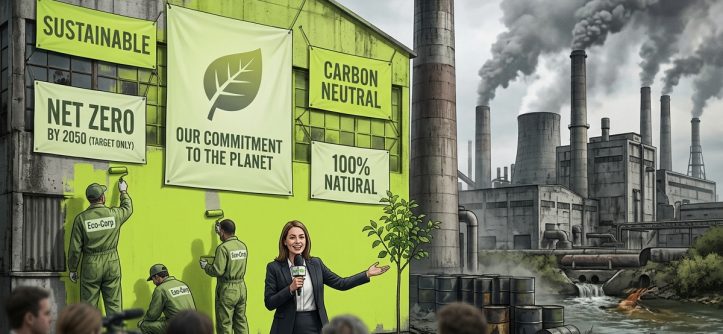
Decades after environmental marketing firm TerraChoice published its groundbreaking report outlining the 7 Sins of Greenwashing, corporate eco-deception has evolved dramatically. What started as vague ‘eco-friendly‘ labels on household cleaning products has turned into multi-million-dollar marketing campaigns. Today, these tactics span every industry from fast fashion to fossil fuels.
Consumers want to buy sustainably. However, deceptive advertising makes it incredibly difficult to tell real environmental progress apart from hollow marketing. Here is a modernized, clear breakdown of the seven sins of greenwashing.
The 7 Sins of Greenwashing: Reframed for Today
1. The Sin of the Hidden Trade-Off
This sin occurs when a brand advertises a product based on a single environmental attribute while ignoring other massive impacts. Essentially, the company highlights a minor positive to distract you from a major negative.
- Modern Example: An electronics manufacturer hypes its use of “recycled ocean-bound plastic” for a smartphone case. However, they conceal the phone’s broader impact. The device itself relies on intensive fossil-fuel energy and destructive rare-earth mining. Furthermore, the company designs it with planned obsolescence, so you must buy a new one quickly.
2. The Sin of No Proof
A company commits this sin when it makes environmental claims without easily accessible evidence or independent, third-party validation.
- Modern Example: A fast-fashion brand launches a clothing collection and claims it uses “sustainably sourced cotton.” Yet, a search of their website, product tags, or annual reports yields nothing. They provide no public certification data, no farm tracing, and no supply chain audits to back up the claim.
3. The Sin of Vagueness
This tactic relies on poorly defined, broad words. The language is so generalized that the consumer cannot understand its real meaning.
- Modern Example: Labels frequently feature buzzwords like “all-natural,” “eco-friendly,” or “green.” Arsenic, uranium, and mercury are completely natural, but they are highly toxic. Without specific context—such as “100% biodegradable within 90 days in industrial facilities”—these words remain legally meaningless.
4. The Sin of Irrelevance
The sin of irrelevance happens when an environmental claim is factually true but completely unimportant. It does not help consumers make a truly conscious choice.
- Modern Example: A manufacturer labels an aerosol spray or refrigeration unit as “CFC-Free.” While true, the Montreal Protocol globally banned chlorofluorocarbons (CFCs) decades ago. Marketing a product as CFC-free today is like advertising a car because it has wheels. It represents a mandatory legal baseline, not a voluntary environmental achievement.
5. The Sin of the Lesser of Two Evils
This occurs when a green claim is accurate within a specific product category, but it distracts consumers from a harsher reality: the entire industry is inherently unsustainable.
- Modern Example: Brands market “organic cigarettes” or “fuel-efficient SUVs.” Organic tobacco avoids synthetic pesticides, but the final product still destroys human health and ecosystems. Similarly, an SUV that gets marginally better mileage than its competitor still creates high carbon emissions compared to public transit.
6. The Sin of Fibbing
This is the most direct infraction. It involves making environmental claims that are completely false. While the original TerraChoice study noted this was rare, recent regulatory investigations prove outright deception still happens.
- Modern Example: The Volkswagen “Clean Diesel” scandal provides a clear example. The automaker installed cheating software specifically to trick laboratory emissions tests. On the road, their vehicles actually emitted up to 40 times the legal limit of nitrogen oxide ($NO_x$) pollutants.
7. The Sin of Worshipping False Labels
This sin involves creating fake stamps, logos, or certification graphics. They look like official, independent environmental endorsements, but the company’s own marketing department created them.
- Modern Example: A product features a bright green leaf icon surrounded by text reading “Certified Eco-Safe Quality.” To a busy shopper, it looks like a legitimate third-party seal. In reality, no legal backing or independent oversight exists behind it.
Modern Greenwashing Dynamics
Greenwashing has entered a more sophisticated era, prompting global regulators to step in with massive crackdowns. For instance, the European Union’s Green Claims Directive and the U.S. Federal Trade Commission’s (FTC) “Green Guides” actively penalize companies that use vague terminology without concrete metrics.
Furthermore, we now see a trend called “greenhushing.” Corporations deliberately hide or underreport their legitimate sustainability metrics because they fear public scrutiny, accusations of greenwashing, or legal challenges from regulators.
Use this quick checklist to distinguish between legitimate eco-friendly efforts and deceptive marketing:
| Green Marketing (Legitimate) | Greenwashing (Deceptive) |
| Uses specific, quantifiable data (e.g., “reduces carbon emissions by 42%”) | Uses broad, generic buzzwords (e.g., “eco-friendly,” “sustainable”) |
| Features verified independent third-party stamps (e.g., USDA Organic, Fair Trade) | Uses self-created, unverified graphics that look like certifications |
| Evaluates the full lifecycle footprint of a product | Focuses on one minor detail while hiding massive environmental harms |
| Provides public links to supply chain data and impact reports | Conceals evidence or provides no proof to back up public claims |
Frequently Asked Questions
What is the primary difference between greenwashing and green marketing?
Green marketing sells products or services based on legitimate, verifiable environmental benefits. It backs these claims with transparent data and lifecycle assessments. Greenwashing uses deceptive, exaggerated, or misleading marketing tactics to make a company or product appear environmentally friendly when it is not.
How can I verify if a green certification label is real?
Look for globally recognized, independent third-party certification bodies. Legitimate eco-labels include Energy Star (for energy efficiency), FSC (Forest Stewardship Council for responsible wood and paper), OEKO-TEX or GOTS (for sustainable textiles), and Cradle to Cradle (for circular design). You can verify a stamp by checking the official registry database hosted by these organizations.
Why do companies greenwash instead of just becoming sustainable?
True sustainability requires substantial long-term investments. Companies must restructure supply chains, alter manufacturing processes, and sometimes accept lower profit margins. Greenwashing is far cheaper. It allows corporations to capture the rapidly growing market of eco-conscious consumers using marketing budgets rather than operational budgets.
What are regulators doing to stop greenwashing?
Government enforcement is tightening globally. The FTC enforces its Green Guides to prosecute deceptive environmental advertising. Meanwhile, the EU’s Green Claims Directive bans generic environmental claims like “climate neutral” or “eco” unless companies can prove excellent environmental performance. Fines for corporate greenwashing can now total millions of dollars.




Leave a Reply