
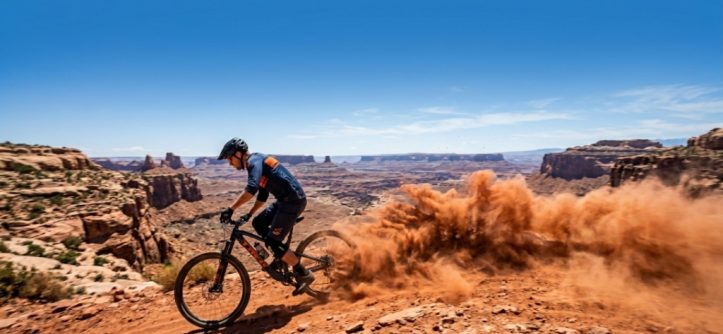
After my first season riding Moab without proper chain maintenance, I totaled two cassettes, three chains, and one chainring — $340 in parts that should have lasted twice as long. The culprit was not riding intensity or bad luck. It was the microscopic red silica dust that turned my inadequately lubed chain into a precision grinding machine that ate through hardened steel like it was cheese. Every rider who has spent time on Utah’s trails knows the sound: that dry rasp that starts subtle at mile 15 and becomes a full scream by mile 30. Keeping your MTB chain lube performing against Utah’s legendary dust requires more than just squirting oil on metal — it demands a systematic approach using dust-resistant chain lubricant products, precise application timing, mid-ride maintenance strategies, and a cleaning routine that removes abrasive particles before they destroy your drivetrain. This guide delivers the complete system that Utah locals use to get double or triple the drivetrain life that visiting riders achieve.
What Makes Utah Dust So Destructive to Mountain Bike Chains?
Utah’s trail dust is primarily composed of silica particles (the same mineral used to make sandpaper) measuring 2–50 microns in size — small enough to penetrate chain roller gaps but hard enough to abrade hardened steel at the molecular level with every pedal stroke.
The destruction mechanism:
- Particle size: Chain roller gaps measure approximately 50–100 microns. Utah’s fine dust (2–50 microns) fits easily inside these gaps — larger dirt particles cannot enter and cause less damage.
- Hardness: Silica (quartz) rates 7 on the Mohs hardness scale. Hardened chain steel rates 5–6. The dust is literally harder than the chain it contacts — meaning it cuts steel rather than being crushed by it.
- Abrasive action: Once inside the roller, dust particles act as a lapping compound. Each rotation of the roller grinds metal against silica, removing microscopic material from pins, bushings, and rollers.
- Cumulative effect: This wear elongates the chain (stretch), rounds roller surfaces, and deforms bushing interfaces — all of which cause poor shifting, chain skip, and eventual failure.
Comparison to other riding environments:
- Pacific Northwest (mud): Water-based contamination that washes out. Damage is primarily corrosion, not abrasion.
- East Coast (loam): Organic soil particles that are softer than steel. Moderate wear rate.
- Utah/Southwest (silica dust): Mineral-based contamination harder than steel. Maximum abrasion rate. 2–3x faster chain wear than other environments.
Which Dust-Resistant Lubricants Actually Work on Utah Trails?
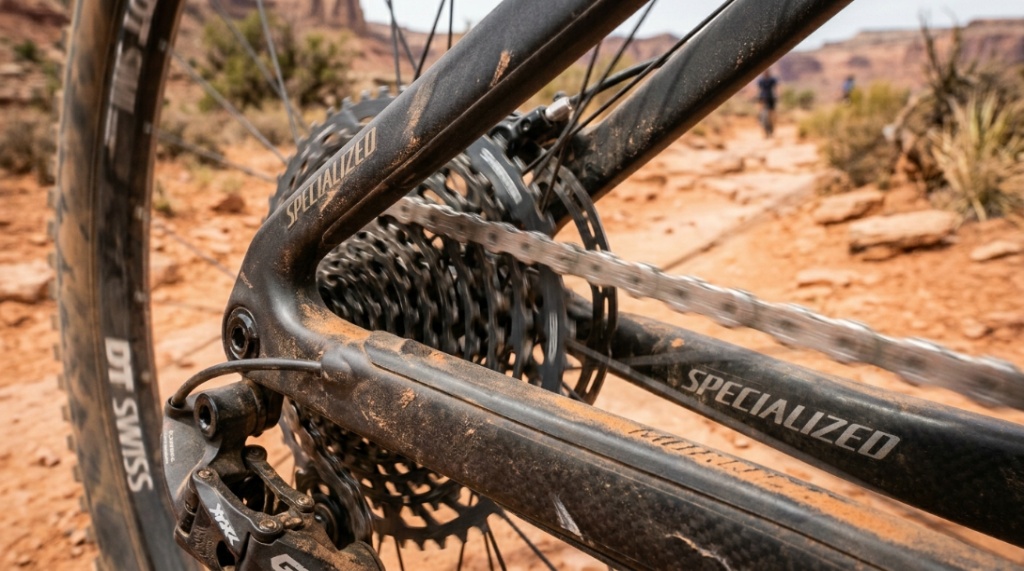
Wax-based dry lubricants that form a solid film after application provide the best dust resistance because they do not create a sticky surface for particles to bond to — keeping chain exteriors clean while maintaining internal lubrication between roller contact surfaces.
Products proven effective in Utah dust:
- Squirt Long Lasting Dry Lube: Water-based wax emulsion. Dries completely. Dust particles cannot stick to the waxy surface. Self-cleaning action — old wax flakes off carrying trapped dirt with it. The most popular choice among Utah locals.
- Silca Super Secret Drip: Advanced wax with tungsten disulfide (one of the slipperiest solid lubricants known). Exceptional longevity — 40–60 miles between applications even in heavy dust. Premium price justified by extended intervals.
- Smoove Universal: Wax-polymer hybrid that forms a particularly tough film. Resists breakdown from both dust abrasion and heat. Slightly harder to clean during reapplication but excellent in-use performance.
- AbsoluteBlack GRAPHENlube: Graphene-enhanced wax. Extremely low friction coefficient. Dust shedding comparable to hot-melt wax in drip format. Requires precise application technique for best results.
- Rex Domestique: High-performance racing wax drip. Originally designed for road racing but excels in dry/dusty MTB conditions. Clean running with minimal dust pickup.
What to avoid in Utah:
- Any “wet” or “all-conditions” lube — these attract and hold dust
- Lubes that remain tacky after drying — they bond with silica particles
- Heavy petroleum-based products — they resist cleaning and trap abrasives
How Do You Apply Chain Lube for Maximum Dust Protection?
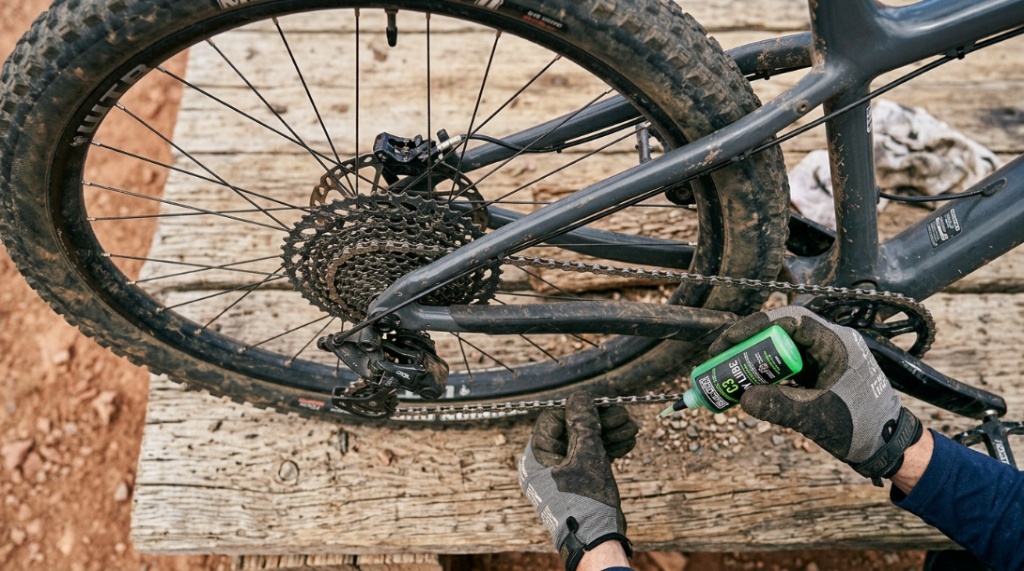
Maximum dust protection requires applying lube to a spotlessly clean chain, using minimal quantity (one drop per roller), allowing complete drying before riding, and wiping all external residue that could attract surface dust — leaving lubrication only inside the rollers where it provides function.
The clean-apply-dry-wipe protocol:
Clean (5 minutes)
- Use a chain cleaning device with citrus degreaser or isopropyl alcohol
- Scrub until the chain produces no grey/black residue on a white rag
- Dry completely — any remaining moisture prevents lube adhesion
- For best results, remove the chain and soak in degreaser every 500 miles
Apply (2 minutes)
- One drop per roller — not per link plate, not a stream along the chain
- Target the roller/bushing interface (top of lower chain run)
- Backpedal slowly while applying to distribute evenly
- Backpedal 30 additional revolutions to work lube into rollers
Dry (15–240 minutes depending on product)
- Allow carrier solvent to evaporate completely
- Wax lubes: minimum 2–4 hours (overnight preferred)
- PTFE dry lubes: minimum 15–30 minutes
- Apply in shade — Utah sun evaporates carrier before penetration
Wipe (30 seconds)
- Run a clean dry rag along the chain exterior
- Shift through all gears while wiping to clean between cogs
- The chain should feel DRY to the touch — any residual tackiness attracts dust
- This step is the most commonly skipped and most important for dust resistance
What Mid-Ride Maintenance Keeps Your Chain Running on Long Utah Rides?
For rides over 30 miles in heavy Utah dust, carry a small drip bottle of dry lube and a rag — reapply at the halfway point by wiping the chain clean, applying fresh lube, backpedaling 20 revolutions, and wiping excess before continuing.
Mid-ride protocol:
- When to reapply: When you hear increased chain noise, feel resistance increase, or notice shifting degradation. Do not wait until the chain is audibly grinding.
- Field application (3 minutes):
- Wipe the chain with a clean rag section (removes surface dust)
- Apply one drop per 3–4 links (less precise than home application but effective)
- Backpedal 20 revolutions
- Wipe exterior with a different clean rag section
- What to carry: Small 2 oz lube bottle, one microfiber rag (folded to provide multiple clean surfaces), in a jersey pocket or frame bag
- Weight penalty: Under 3 oz total — negligible compared to drivetrain replacement cost
Mid-ride reapplication is not ideal (you are applying over some existing contamination), but it is dramatically better than riding on a dry chain for the remaining 20+ miles. The lube provides a sacrificial layer between metal and abrasive particles even if it cannot fully clean the existing contamination.
How Does Riding Style Affect Chain Lube Longevity?
High-torque riding (climbing, technical grinding) depletes chain lube 30–40% faster than smooth spinning because increased force between chain components squeezes lubricant from contact surfaces — meaning climbers and technical riders need shorter reapplication intervals than flow-trail riders.
Riding style impact on lube consumption:
- High-torque climbing (granny gear, steep grades): Maximum force on chain rollers squeezes lube from between surfaces. Combined with slow chain speed (less centrifugal distribution), climbing burns through lube fastest.
- Technical riding (frequent gear changes, stop-start): Lateral chain flex during shifting scrapes lube from roller sides. Frequent acceleration loads spike roller-to-bushing pressure.
- Flow trails (consistent cadence, minimal shifting): Lowest lube consumption. Steady force distribution and consistent chain speed allow even lubricant distribution.
- Downhill (minimal pedaling, high speed): Lowest consumption due to minimal load. However, high wheel speed kicks up maximum dust exposure.
Practical adjustment: if your ride involves sustained climbing (like the Whole Enchilada’s 7,000-foot descent that requires climbing access roads), apply lube before the climb section specifically. The descent will not deplete your lube significantly, but the climb approach can empty it before you reach the fun part.
When riding through heavy desert silt, proper drivetrain care is identical whether you ride modern nimble setups or classic builds. Dusty terrain aggressively impacts both 26 and 27.5 Inch Mountain Bikes, meaning riders on any wheel size must prioritize a dedicated dry-lubricant routine to prevent premature gear wear.
What Cleaning Routine Prevents Dust Damage Between Rides?
A post-ride wipe plus a deep clean every 2–3 rides prevents Utah dust from accumulating inside chain rollers to damaging concentrations — the 5-minute post-ride habit saves more drivetrain life than any other single maintenance practice.
Cleaning schedule for Utah riders:
After every ride (2 minutes):
- Wipe the chain with a dry rag while backpedaling
- Wipe cassette with a rag threaded between cogs
- Wipe chainring teeth
- Wipe derailleur pulleys
- This removes 70% of surface contamination before it works into components
Every 2–3 rides (10 minutes):
- Full chain cleaning with a chain cleaning tool and degreaser
- Brush cassette with a stiff nylon brush
- Wipe derailleur pivots and spring areas
- Rinse with water if using water-safe degreaser
- Dry completely, then reapply fresh lube
Monthly deep service (30 minutes):
- Remove chain and soak in degreaser for 30 minutes
- Remove cassette and clean individual cogs
- Clean chainrings front and back
- Flush derailleur pulleys (remove if possible)
- Inspect chain wear with a checker tool
- Reinstall and apply fresh lube with full drying protocol
For product-specific cleaning recommendations and performance data from Utah’s dustiest trails, MTB chain lube reviews for Utah conditions provides detailed maintenance protocols tested on local trails — including which products clean easiest and which require specific removal techniques.
Conclusion
Keeping your MTB chain smooth on dusty Utah trails requires a three-part system: the right lubricant (wax-based dry formulas that shed dust), correct application technique (clean-apply-dry-wipe with no external residue), and consistent maintenance routines (post-ride wipe, periodic deep clean, timely chain replacement). Utah’s silica dust is harder than your chain steel — the only defense is preventing particle accumulation through proper lubrication and regular cleaning.
Local riders who get 2,500+ miles from a chain in Moab’s dust all follow this same system. It adds 5–10 minutes per ride and saves $200–$400 per season in premature drivetrain replacement. The investment is time, not money — and the payoff is a quiet, smooth-shifting drivetrain that performs as well at mile 40 as it did at mile 1, even through Utah’s most punishing red-dust conditions.
What is your dust-fighting chain routine for Utah trails? Share your system every local rider has tips that could save someone else a costly premature replacement.
Frequently Asked Questions
How many miles should a chain last in Utah dust?
With proper lubrication and cleaning, a quality 11/12-speed chain should last 1,500–2,500 miles in Utah conditions. Without proper maintenance, that same chain may reach 0.5% wear in as few as 500–800 miles. The difference is entirely maintenance discipline — same trails, same rider, but 3x lifespan difference based on lube choice and cleaning routine.
Can I use chain wax in hot Utah summers without it melting?
Modern wax chain lubes (Squirt, Silca, Smoove) are formulated to resist melting up to 150°F+ — well above any ambient temperature you will encounter riding. The wax film remains solid and functional even on 110°F days. Only hot-melt wax applied via immersion needs temperature consideration, and even that sets at temperatures well above riding conditions.
Should I lube my chain before or after riding in dust?
Before. Fresh lube provides a protective barrier that resists dust penetration during the ride. Applying after riding (without cleaning first) seals dust inside the chain. The correct sequence is always: clean → lube → ride → wipe. Never lube over a dirty chain as routine practice.
Does chain speed affect how much dust enters the rollers?
Yes — higher chain speed (faster cadence) creates slight centrifugal force that helps prevent dust entry, while also distributing lube more evenly. Slow, grinding cadence allows more dust settling time on chain surfaces. Maintaining a moderate cadence (80+ RPM) versus mashing (50–60 RPM) provides a small but measurable dust-reduction benefit.
Is it worth switching to a wax-immersion system for Utah riding?
For riders covering 100+ miles per week in dusty conditions, wax immersion provides the best possible drivetrain longevity and cleanliness. It requires removing the chain every 150–200 miles for re-waxing (30 minutes including melt time). For riders under 50 miles per week, quality drip wax lube provides 80% of the benefit with far less effort.
Do chain guides or chain slap protectors help with dust?
Chain guides prevent chain drop but do not reduce dust entry into rollers — that happens at a microscopic level regardless of chain stability. Chain slap protectors prevent frame damage but similarly do not affect lubrication. These are useful components for other reasons but do not contribute to dust protection or chain longevity.
What about ceramic-coated chains for Utah dust?
Factory ceramic-coated chains (like those from CeramicSpeed) provide measurably lower friction and slightly better dust resistance than standard chains. However, at $100–$200 per chain versus $25–$50 for standard chains, the cost-per-mile advantage only materializes for high-mileage riders. For most recreational Utah riders, a standard chain with excellent lube discipline outperforms an expensive chain with lazy maintenance.




Leave a Reply