
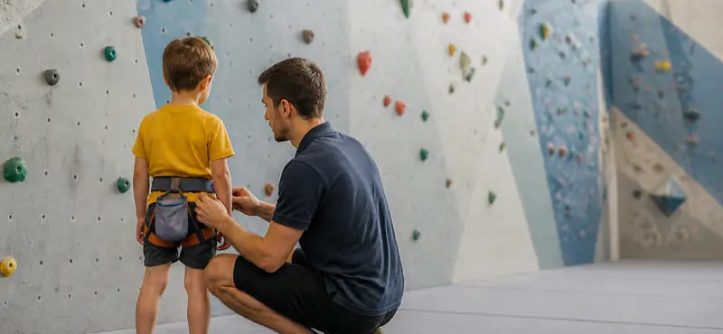
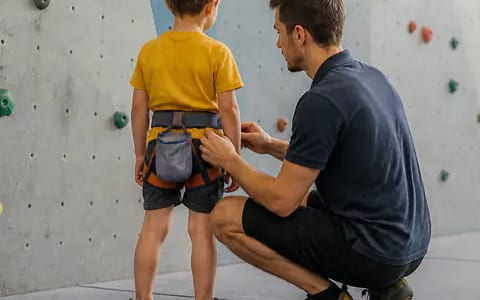
A young boy with very little spoken language sits at the foot of a climbing wall. His harness is checked and the staff member carrying out the check follows the boy’s eyes to his hands to see what he is going to do next.
A great article has been written by the BBC News about 5 year old Albie and his speech delay, taking to the climbing wall with his family. The article makes some good points as to how climbing can help children with speech delay, and this works best when staff on climbing walls are able to adapt their communication to make connection with children who do not speak a lot of language, without always resorting to spoken language.
Connection without many words
Albie’s bonds with staff on the wall have formed through the strong connections that have been built through his routine with the staff on the wall, consistent behaviour repaid with strong connections and understanding with the child. This has been achieved through his seeing the same staff members every week, some on a daily basis and them in turn recognising the child’s behaviour and using consistent hand signals to tell the child what he needs to do next.
As Albie’s mum Corrie said, he ‘feels seen’ whilst doing climbing. He receives immediate feedback on his attempts to climb i.e. he is up or he is not. This feedback does not need to be given in spoken language.
What the numbers say about demand
There’s nothing unusual about this. The latest special educational needs statistics from the Department for Education (DfE) for 2024/25 show that 33.6% of the 482,640 pupils in England with an EHC plan have autism as their primary need. An EHC plan is the formal document which outlines the support a child with significant needs needs in order to access education. Many leisure and activities venues are likely to come into contact with children and young people on the autism spectrum with associated communication needs.
Where the advice bends
Incorporating this type of activity into a child’s life can be highly beneficial however it is the adaptation of normal communication that makes the activity inclusive to children with communication needs. A short introduction to the activity before the child starts is key to ensuring the child knows what to expect and is prepared for the activity. It is also key that the child has sufficient time to complete each aspect of the activity and that staff are patient with the child’s progress.
So therefore, as a parent looking at a Climbing Wall Birmingham, you might ask how staff adapt the activity for children with communication needs. Ask them how they communicate the activity to the child before it starts and will the same staff be there each week.
Why this holds up for Albie’s centre
Again this is central to the approach at 270 Climbing. Their NICAS Ascend adaptive award scheme is being piloted with Active Gloucestershire and I would be interested to read the findings of this to see how it can help other centres too.
Albie’s experiences reflect the way staff at the centre are currently working with him. It would be good to learn from the findings of the pilot and hopefully 270 Climbing can provide other centres with a working model.


Leave a Reply